Since 1868
The Lewis & Conger Story
The Finest Home & Life Goods since 1868
The beginning
A classic name returning to a new American table.
It began in 1835, in a downtown New York housewares shop — a quiet trade in pots, pans, and the everyday objects of a young city’s kitchens.
The shop was J. & C. Berrian, and it had been selling housewares in downtown New York since around 1835 — the same decade Tiffany & Co. opened its doors. A generation later, it took on the two messenger boys who would one day give it our name.
Our founder Richard V. Lewis came to America from Wales in 1855, at fourteen. Two years later he took work at Berrian as a two-dollar-a-week messenger, alongside a fellow messenger named Henry C. Conger. Together, as The New York Times later told it, they “delivered pots and pans throughout the city in baby carriages.”
Born in 1868
A name of their own
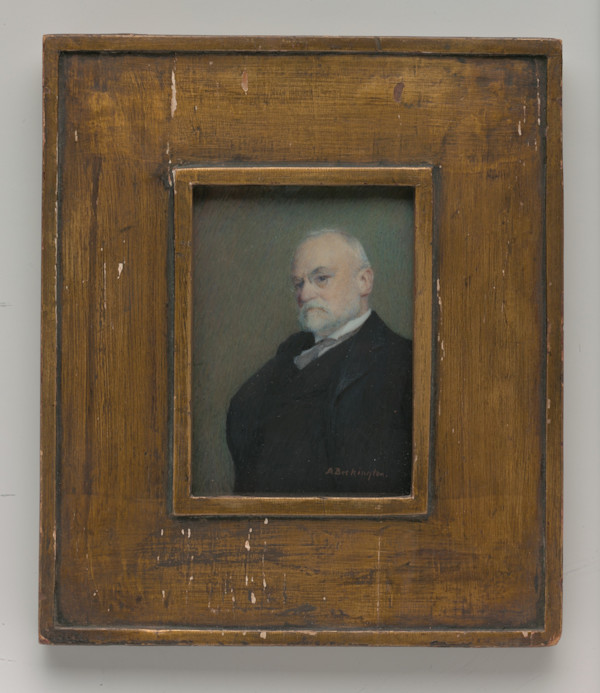
Lewis left to serve in the Union Army. When he came back, the store asked him to take over its management — and he agreed on a single condition: that Conger run it with him, as an equal. In 1868 the doors reopened under a new name, Lewis & Conger, and the store settled at 601 Sixth Avenue, near Herald Square.
The new name didn’t begin a new idea so much as carry an established house forward — the next chapter of a trade already a generation old, now run by the two men who had started at the bottom of it.
Nine floors of the well-made
One of New York’s most complete houses
By the early twentieth century, Lewis & Conger had become one of New York’s most complete suppliers of housewares — its house-furnishing warerooms filling a building on West Forty-second Street, every window a department of its own.
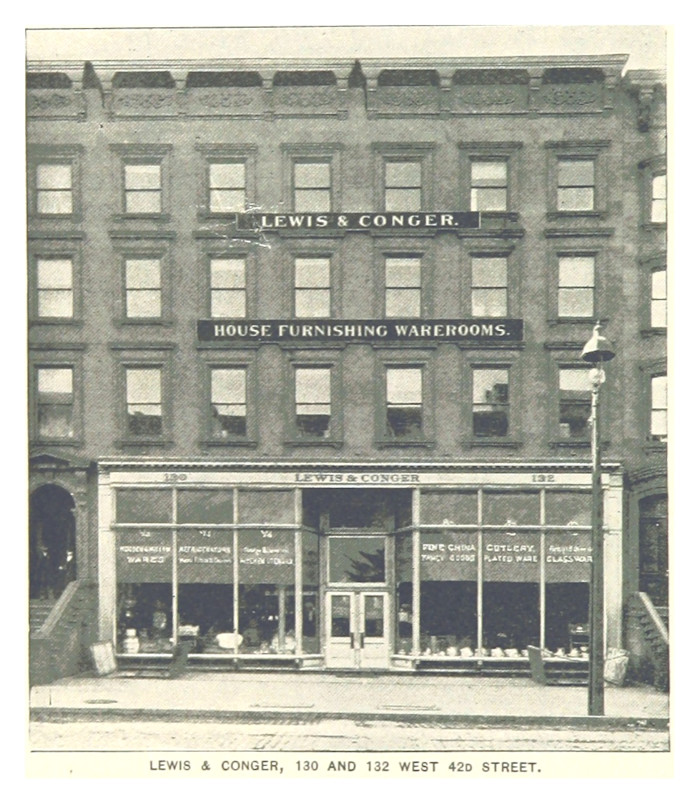
In 1912 it moved into its own nine-story building at the southeast corner of Sixth Avenue and Forty-fifth Street — “Nine Floors of Household Equipment,” as the store’s own advertisements put it. What filled those floors was the whole apparatus of a well-run home: kitchen utensils, cutlery, copper and brass, china and glass, refrigerators. But breadth was never the point — selection was. The store kept a standard, and said so plainly:
To find a place on our floors an article must be well-designed, well-made, lasting, and serve a useful purpose. And the price is always in keeping with the quality.
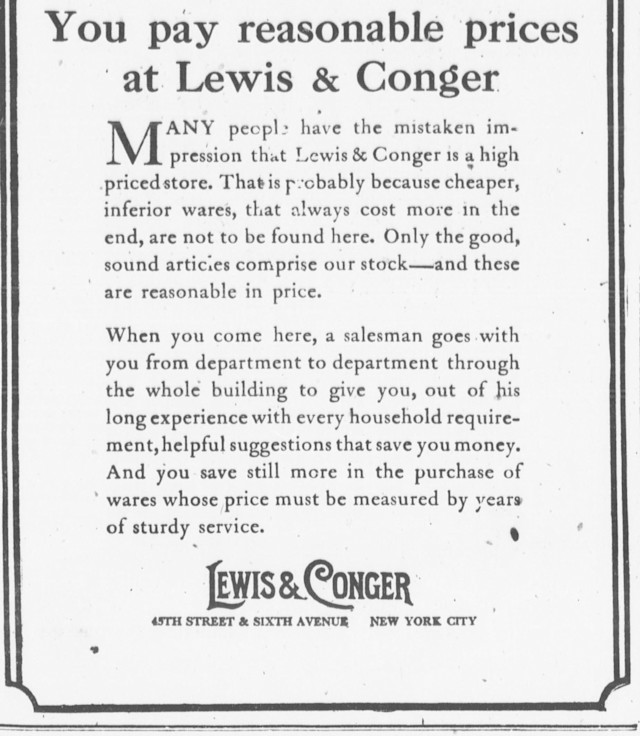
It was not, the store insisted, a high-priced shop. As a 1920 advertisement explained, “cheaper, inferior wares, that always cost more in the end, are not to be found here” — only “wares whose price must be measured by years of sturdy service.”
A 1918 advertisement promised a shopper could find “anything from a measuring spoon to a breakfast tray, from a gong to a refrigerator, from an hour glass to a sterilizer.” And a salesman walked each customer from department to department, offering, free of charge, the finest quality possible at reasonable rates.
A name worth trusting
Vouched for at the highest level
A store that curates earns a kind of authority, and Lewis & Conger spent decades earning it — becoming the place to find what you couldn’t find elsewhere. Its floors were an early home for the new household gadgets of the age, and the name carried weight far beyond Sixth Avenue: manufacturers across the country advertised that their products had won the “Lewis & Conger Safety Award.”
The taste was vouched for at the highest level. Henry Clay Frick — whose Fifth Avenue mansion is now the Frick Collection — kept his household in kitchen supplies from Lewis & Conger; a decade of the receipts, 1904 to 1914, survives in the Frick Collection archives. And when the Museum of Modern Art mounted its 1939 exhibition of well-designed, useful household objects, it chose pieces sold at Lewis & Conger.
Its Sleep Shop — “a retail store of singular distinction,” one 1953 news caption marveled, and “the only one of its kind” — gave over a whole department to the science and comfort of rest. And long before the internet, the store reached homes far from New York by mail — a national habit of ordering the good and useful thing, and trusting it would be right.
The same standard, a new century
Chosen the way they always were
The trade evolved — from hardware to house-furnishing to housewares to the modern, curated home — but the standard the house was built on never did: well-made, genuinely useful, made to last, and fairly priced.
More than a century and a half after two messenger boys reopened a store under their own names, we’re opening the doors again — online now, and shipping nationwide. We hold to the same idea that earned the name in the first place, because the standard hasn’t changed — and because it’s ours.
The finest home & life goods, chosen the way they always were —
because they’re worth keeping.
Sources & image credits
- Richard V. Lewis, portrait miniature — Alice Beckington, c.1910. The Metropolitan Museum of Art, Bequest of Katherine Lewis, 2001. Public domain (CC0).
- 1893 storefront engraving — King’s Handbook of New York City, 1893. British Library (Mechanical Curator collection). Public domain.
- 1918–1920 advertisement quotations & wordmark — Lewis & Conger advertisements; the 1920 ad from The Evening World, November 4, 1920. Library of Congress, Chronicling America. Public domain.
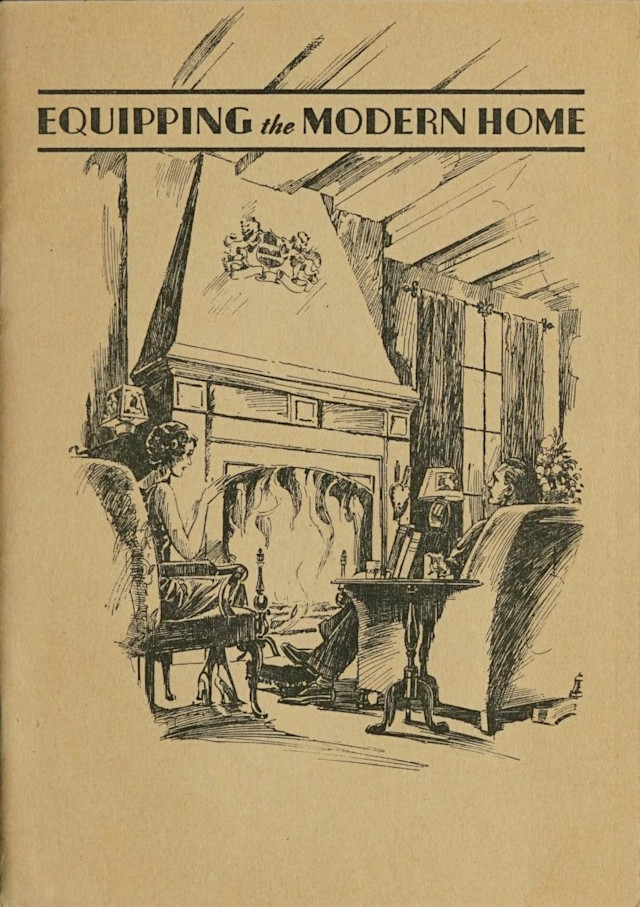
- “Equipping the Modern Home” catalogue — Lewis & Conger, 1930.
- Frick household receipts — “Lewis and Conger (New York, N.Y.), 1904–1914: kitchen supplies.” Henry Clay Frick Papers, Series IV: Receipts. The Frick Collection Archives.
- Founding & name history — The New York Times, July 25, 1955 and January 31, 1956. “Sleep Shop” — press caption, 1953.
- 1919 credo quotation — Lewis & Conger advertisement, 1919. MoMA endorsement — Useful Objects Under Ten Dollars, 1939.